One thing that I’ve learned from years of practicing clinical hypnotherapy, is that when I ask somebody why they have a behavior, or why they did something, the first answer they give me is a B.S.. Before I explain, let me first explain what I mean by B.S..
In a game of cards, bluffing is when a player pretends to have a better hand than they really do, by covering up the truth about what they feel, and why they are betting in a certain way.
Similarly in real life, B.S. is when a person pretends to have a better situation than they really do, by covering up the truth about what they feel, and why they are acting in a certain way.
The problem with telling the truth, is that for most people, the truth isn’t good enough. You probably don’t have to think very hard to remember a time when your mom or dad was upset at you for something, and when you tried to explain why it happened, they refused to listen until you gave them a “better” reason. And it isn’t just parents, it’s everybody. The problem, of course, is that after giving enough other people B.S., we start using B.S. on ourselves as well. When that happens, a lot of bad things can start to happen.
You see, we all have things we need in our life. I’m not talking about Maslow’s hierarchy of needs, like food, shelter, love, and socializing. I’m talking about specific needs that often don’t get addressed, or even acknowledged.
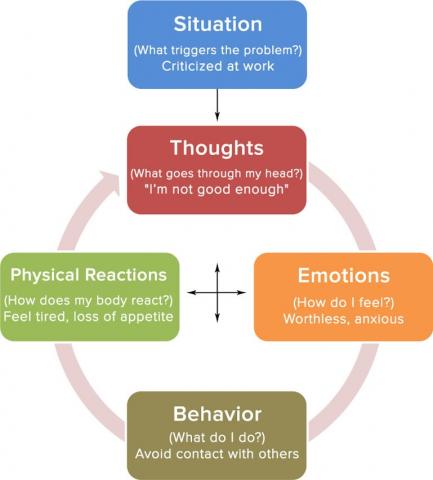
Thought → Emotion → Behavior → Symptom
Thought.
One rule of the mind, is that your subconscious will tell you what it needs, no matter what. When you first start ignoring yourself, it’s easy. You know what you need, but maybe it’s not the right time at the moment. Or maybe it means giving up something else that you want. Or maybe you just decide that it isn’t practical. So after a while, your subconscious moves on.
Emotion.
You can’t just ignore your needs and hope they go away. They always, always make themselves known whether you want them to or not. So when you ignore a need for long enough, it becomes more insistent, and starts showing up emotionally. Emotions, are by their nature, harder to ignore. Many people notice something is wrong when they start feeling emotions that seem out of place. It’s not out of place, but it might seem like it, because you aren’t acknowledging the need behind it.
Behavior.
Unfortunately, this is where your subconscious gets serious. In western culture, we are taught very effectively to ignore our emotions, but when we do, it costs something. This is where you start having trouble with bad behaviors, habits, and addictions. Maybe it’s smoking, or overeating, or alcohol, or something else. It usually starts small, and isn’t really a problem until later, but it can get bigger, fast.
This is when most people start to acknowledge the problem, when it starts to affect our actions. That would be fine, except that by this point, the behavior looks very little like the need that started it, and most people aren’t even aware that the problem goes deeper. Most people try to suppress the behavior with willpower. For a lot of people, that’s impossible. Willpower isn’t really a very good method for dealing with a lasting problem. It works on short term problems just fine, but over longer periods, it usually breaks down. At this point, you have your habits and emotions working against you, and it’s rare that people can overcome both with willpower alone.
Symptom.
Some people do, however, suppress need-based behaviors for long periods of time. I wish I could say that this is the end of the story. But like I said earlier, needs must be expressed. It’s a law of the mind, and in many years of working with clients, I haven’t seen an exception. So if your subconscious can’t get your attention with thoughts, or emotions, or behavioral symptoms, it goes physical. For me, it was Asthma. My subconscious was telling me that I needed to slow down and breath, and I didn’t listen, so it found another way to get my attention.
I want to be very clear, physical symptoms are just as likely to have a cause in your subconscious as behavioral or emotional symptoms. I could tell you story after story about people who came into my office with a physiological problem that doctors couldn’t figure out, who left fully healed. My rule of thumb, is that the body’s natural state is to be healthy, so if something isn’t healing right, or isn’t healing at all, there is a good chance that it’s subconscious.
By the way, just because it starts in the subconscious, doesn’t mean it’s made up. I’ve seen bent spines, heart attacks, and many other objectively real symptoms that stemmed from a subconscious need. It’s all very real.
So that’s the bad news. The good news is: there is a solution. I’ll talk about some of the things you can do to prevent, and correct many of this on your own, and obviously, I’m going to talk about what a qualified hypnotherapist can do to help in another article.